Why do most account plans never change what you do?
The first time I brought an account map to our CEO to ask for his help on a particularly large deal, he called it "perfunctory." After quickly googling the definition, I realized he was right. I'd laid out every contact in a colorful chart with their title, buying role, and reporting line, and I'd even added headshots and contact information.
But here's the point I missed: the map was documentation. It didn't show who needed to say what, to who, and when, to keep the deal moving.
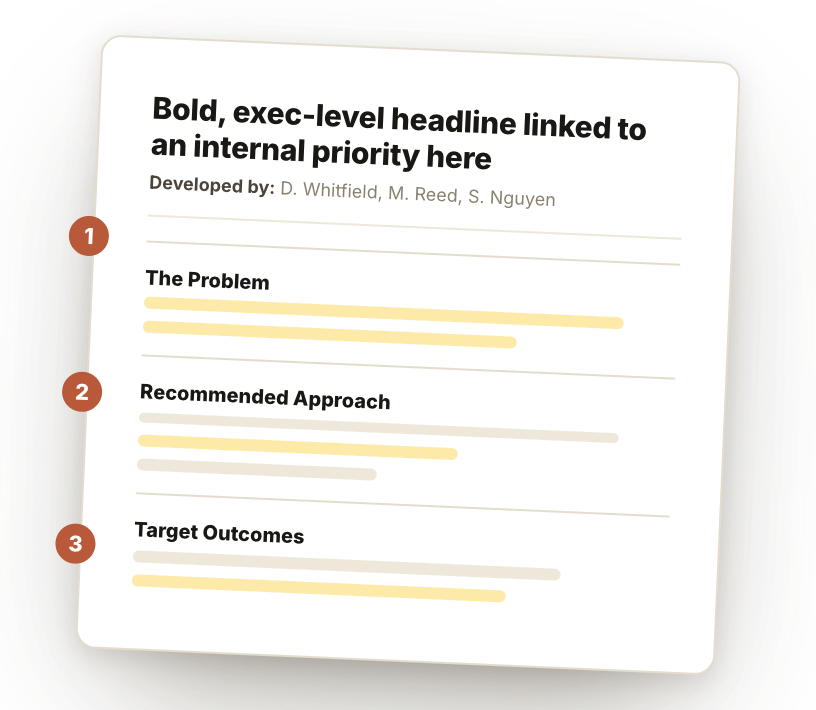
Most account plans have the same problem, just bigger. They collect revenue, headcount, the org chart, the products the customer already owns, and the relationship status by contact, which is all accurate, and it still won't tell you which conversation to have on Monday. So this plan starts from what the executive is trying to do, turns your research into a point of view about it, and ends with three opportunities and the next conversation for each, all on two pages.
What goes on page one?
Page one is the account's situation, from the executive's priority down to the alternatives you're competing with. Four blocks:
1. Your point of view. Four sentences, the same shape as a 4-sentence soundbite: because of a major shift in their business or market, now's the time for them to take an approach you uniquely enable, which leads to positive outcomes while avoiding the cost of negative ones. Above it, write the three-year, board-level vision you're guiding them toward, what's changing in their environment that creates more need for you, and one insight into the account nobody else is bringing.
2. The executive priority and its timing. Name the executive pushing a strategic goal, the internal projects they've created to support it, and the milestone and date they're working toward. That date is your compelling event, and if you can't find one yet, write down what waiting costs them instead.
3. The people who'd carry your point of view. List the handful of people who'd bring it to the executive, with how much influence each one has, what they care about most this year, how strong your relationship is today, and the next question you need to ask them. Influence won't always line up with title. When Carta CEO Henry Ward mapped influence inside his own company (it was a smaller company at the time), nine individual contributors turned out to influence 70% of the staff, and in his words, "Both fascinating and humbling, I am the CEO and didn't make the top 10."
4. Alternatives and account health. List what you're really competing with: another vendor, an in-house build their CTO is exploring, a competing priority that could pull the team's focus, or simply the status quo. For existing customers, add what you know from usage data, how they operate differently from your other customers, and what's changed about your standing with them this year.
How do you keep page one honest about what you don't know?
Start with a real signal, like a hire, a launch, a line from their earnings call, or a change in how they operate. A point of view with no evidence behind it reads as a pitch.
Then mark every claim on the page. Confirmed means they said it, or it's public. Inferred means it's your hypothesis, and you still need to test it. Which turns the plan into a discovery agenda, because every inferred claim is a question for your next conversation. (There's a deeper walkthrough of building the point of view itself in how to build a point of view before discovery.)
Now, aim it as high as you can. It takes a lot longer for a message to travel up the corporate ladder than back down it, so a point of view built around the executive's priority gets to the people who decide far faster than one built from a manager's workflow.
What goes on page two?
Three opportunities, each tied to an executive priority from page one, and each with the same four parts:
- Signal: The research on why change, and why now, with its source
- Problem: Their current state, recapped in their words, and who owns it
- Product and payoff: Which use case or product set, your right to win it, and the outcome they get in the future state
- Next conversation: The key influencers, connections, and executive intros you'll need, starting with the next conversation, its owner, and its date
Then explain why these three, using three lenses:
- Product whitespace. Are the products sequenced so each win sets up a stronger position for the next one?
- Stakeholder whitespace. Are you using the relationships you already have to reach adjacent teams faster?
- Account health. Does usage or outcome data point to a real expansion opening?
And write down what evidence would change the plan, so you'll know it when you see it. The best expansion signal is usually a new executive with a new mandate, by the way.
Which opportunity should you work first?
The one tied to the executive's top priority, ranked by impact and how easy it is to get into. For an existing customer, the fastest way into a new team is usually a warm intro from a happy one, so draft a short note your current champion can forward. Write it around the value to the new team, and make it a single easy step for them.
"We don't have time to write a plan for every account."
Which is exactly why it's two pages. Start with the accounts where the executive priority is clearest, and keep each one current by updating three things: the point of view, the three opportunities, and the next conversation for each. Keeping those current is a page edit each week, so the plan never turns into another quarterly project.
Your move this week
- Pick your top account and write its four-sentence point of view, marking each claim confirmed or inferred.
- Name the executive priority and the date behind it.
- Fill in one opportunity on page two, all four parts, and book the conversation it points to.