Why doesn't adding more contacts fix a fragile deal?
"My champion's running pricing up the flagpole, so we're at 50%."
That's something I've said about a lot of deals. Which subsequently exploded.
Your champion can be all-in on the project, but map the rest of the group against the buying process and you'll usually find a manager selecting a vendor, a VP still debating the approach, an operations team that hasn't committed to the problem, and an executive focused on a different priority altogether. All inside a single deal record, with one probability attached to it.
So the standard advice kicks in: multithread, which usually gets heard as "add more names to the CC line."
But in 1944, the OSS (the CIA's predecessor) wrote a field manual teaching ordinary people how to quietly sabotage enemy organizations from the inside, and one of its tips was to refer everything to committees "for further study and consideration," and to "make the committees as large as possible." Never less than five people. Which means adding people to a decision, by itself, is a documented sabotage tactic.
So which is it, is a single-threaded deal fragile or is a big committee dysfunctional? Both. The job is to add the people the decision actually needs, at the stage it needs them, and then stop.
What does multithreading mean in sales?
Multithreading means building relationships with several people in a buying group, so your deal doesn't live or die with one contact. The way I'd put it: you're getting the right people into the conversation at the right stage, and tying them together with one message they can all repeat. If those threads never connect to each other, you've just opened more loops to follow up on.
So the question worth asking in your next deal review is whether this group can make a decision together, and what you can do to help them get there.
Why can't one great champion carry the deal?
A few reasons:
- Champions always move faster than groups reach consensus. Your champion may be all-in, but if the committee around them doesn't even agree on the problem, you're back at step one.
- So the deal stage you log is really your champion's stage. Most reps forecast off the handful of contacts who are engaged, instead of how the group is behaving, which is how you end up with a "50%" deal where half the committee hasn't agreed on the problem yet. Moving those deals backward drives sales leadership nuts, I know. It's still better to be accurate than to commit to what won't close.
- Selling with you costs your champion something. A buyer who owns $15 million of IT spend at a Fortune 500 software company put it to me this way: "I have a bare minimum of 5 people I need to get on board with any new purchase... long after the rep for this deal leaves, I still live here." Every ask spends their social capital, whether or not your deal ever gets signed.
- And skeptics object without you. Skeptics hold more power than advocates, because their concerns get weighed more heavily than everyone else's enthusiasm. It's also a lot easier for a skeptic to stay quiet on your calls and save the objection for an internal meeting about you, without you.
Put those together and a responsive champion can hide a fragile deal. If your sale feels too smooth, there's a good chance your champion is sanding down the friction alone, settling every disagreement before you ever see it.
Can you be too multithreaded?
Yes. Every person you add is a relationship that has to stay aligned with every other person in the group. Fred Brooks did this math for software teams in The Mythical Man-Month back in 1975: n people = n × (n − 1) / 2 lines of communication. So six people = 15 handshakes to keep in sync, and twelve people = 66.
CEB (now part of Gartner) put numbers on what that does to a purchase. In their research, purchase likelihood fell from 81% with one decision-maker to 55% with two, and to 31% with six (Harvard Business Review, 2015). The data stops at six. I think they didn't want to scare us with what happens after that.
So why do committees keep growing? Usually because confidence is low, and unconfident groups do one of two things:
- They keep looking for more input, swimming around for one more opinion to stay afloat.
- They let someone else decide, which shifts the blame if it goes south.
Both add people who can say no without adding anyone who can say yes. Pair that with the enterprise's favorite decision, doing nothing, and you can see why close rates fall as the circle swells. So treat an ever-growing committee as the canary in the coal mine, and aim for a minimally viable committee: just enough people to confirm the problem, build the use case, and clear the contract.
How do you map a buying group?
Start with who can say no. There's no such thing as one decision-maker: there may be one economic buyer who signs the contract, but everyone in the group who can say no is a decision-maker too, because "no" is just as clear a decision as "yes."
And influence rarely follows the org chart. It lives in social capital, internal reputation, and back-channel conversations more than in hierarchy and formal approvals. One of the best questions I know for surfacing it: "Is there someone you often turn to for advice on new projects?" It pulls people out of the shadow org chart and into your committee.
Then plot everyone on two axes, influence (can they change the direction of the decision?) and advocacy (are they for it?):
- Champion = high influence, high advocacy. Arm them, but don't exhaust them.
- Cheerleader = high advocacy, low influence. Good air cover, but they can't move the decision alone.
- Skeptic = high influence, low advocacy. Your highest-ROI call, and the one most reps avoid.
- Bystander = low on both. Recruit them, or drop them from the thread.
For each person, note the part of the decision they own or can veto, their #1 goal this year, and the stage where you'll need them. That last one is what keeps you from adding contacts at random.
Threading the needle between a dozen people's goals is tough stuff, and the simplest tool I've found for tying them together is two words, which means, linking each layer of the group to the next:
Reps spend more time prospecting than managing pipeline, which means... sales directors don't have the coverage to hit team quota, which means... the SVP misses their goal of returning 4x each seller's fully loaded cost.
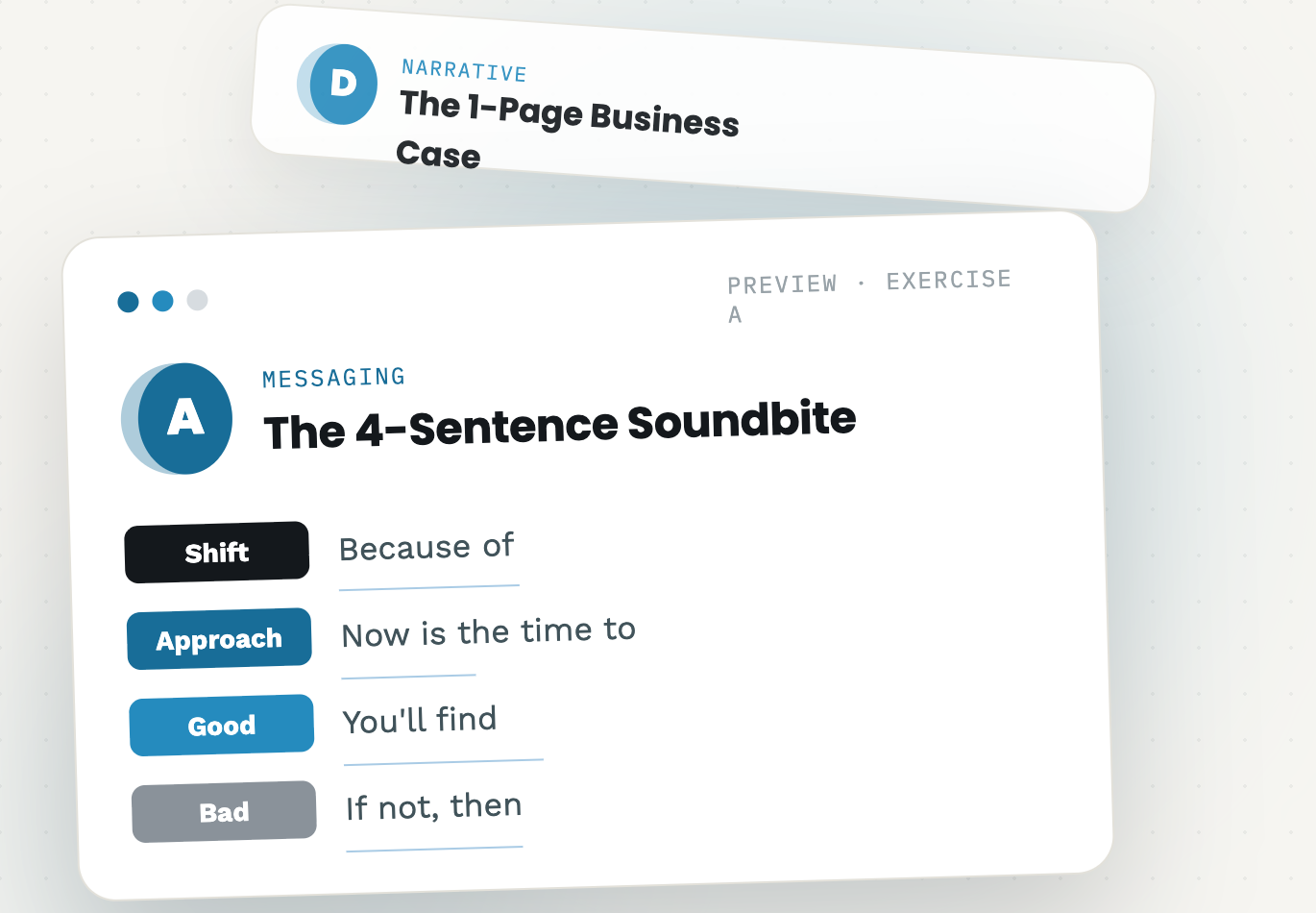
Now the rep, the director, and the SVP can all see themselves in the same sentence, and a sharp 4-sentence soundbite is the version of that chain short enough to be retold in rooms you'll never enter.
When should you bring each person in?
Sequence your threads by what the decision needs at each stage. Adding a VP because your manager asked "are we multithreaded?" in pipeline review is how you end up with random threads. So ask: what's the gap at this stage, and who closes it?
- Discovery: The usual gap: No signal from the economic buyer; The move: Pre-wire them with a one-page "what we heard" note
- Qualify: The usual gap: Skeptics are invisible; The move: Ask who might disagree, then name them
- Demo: The usual gap: The people who'd use it aren't in the room; The move: Invite them
- Propose: The usual gap: Legal or IT shows up as a surprise; The move: Ask about vendor onboarding, loop them in now
- Negotiate: The usual gap: Your champion is carrying it alone; The move: Activate the exec sponsor
- Close: The usual gap: A silent "no" from above; The move: Run a "who hasn't spoken?" audit
The first row is the one most teams skip. Get high early, win later: surface the economic buyer in discovery, before you build any business case, instead of treating them as a prize at Propose.
The other row that bites late is Propose. In a recent pipeline review with an enterprise team, sellers kept protecting the deal from security, legal, IT, and procurement until they "had a yes," and those teams kept surfacing at Negotiate and adding weeks. So ask "What's your vendor onboarding process?" while you're still qualifying. Procurement isn't paperwork, it's a gate with a vote.
How do you multithread without going around your champion?
Work with them, not around them, whenever you can. In practice that's five moves:
- Give them the choice of how. When your champion mentions keeping their VP posted, offer two paths: "I can either write them a quick update cc'ing you and [your exec], or I can send it to you, so you can add and forward on while cc'ing us. What would you be more comfortable with?" Either way the VP joins the thread, and your champion stays in control of it.
- Mirror the access you want. Bring an executive, meet their executive. Bring a technical team, meet their technical team. Work in your own silo, and they will too.
- Invite, with an easy out. Your champion can't introduce you to someone they don't know (I've run group calls at a large health insurer where four business units were meeting each other for the first time). So once your champion knows it's coming, reach out directly: "I was hoping to include you in a conversation about [internal priority] with the [business unit] team next week. Would it make sense for you to weigh in? If this doesn't sound relevant for you now, all good." Nobody was ever mad they got invited in early.
- Invite the disagreement, too. My dad once told my mom he'd be happy to join her on a trip to Miami she was planning. Before they were dating, and she hadn't asked him. They're still madly in love 40-plus years later, and I exist because of that self-invitation. Invite yourself into the conflict the same way: "Seems like everything's moving forward smoothly, so I'm wondering, is there someone on your team who might be willing to disagree with us, so we can be sure we have a good fit?" The person who gets nominated is usually the strongest critic.
- Give your champion a rest week. By Negotiate they're tired, and every new ask adds drag. Send updates with no asks, and pick up the coordination yourself: draft the security, legal, IT, and procurement emails they can forward, with the exec sponsor cc'd.
Most of those moves happen in writing, which is why the forwardable email is the cheat code for multithreading. And once the group agrees on why to act, which is the job of a 1-page business case, a mutual action plan keeps every thread pointed at the same date.
What do you do when the buying group is dysfunctional?
Some conflict is healthy, it means people care enough to disagree. But when a right-fit deal keeps stalling, you're usually looking at two kinds of problems. Math problems have solutions: they're about what you're selling. Drama doesn't: it's about people, and the stories they tell themselves about their jobs. And math problems usually go unsolved because of the drama around them.
One case from Selling With: a retailer's customers couldn't find answers in their help content, so they kept asking for a human. The math problem was simple (more inquiries than staff), and a search tool that understood the intent behind a question fixed it. It still took forever, because:
- The VP of support had pushed for a big help-content project in the first place, and felt her reputation was on the line.
- The support manager kept saying he was too busy to look at a fix, because the backlog felt like job security.
- The e-commerce director was nervous about his conversion targets, and blaming support was easy.
Making sense? The drama was keeping each of them safe, needed, or blameless, and the deal moved once each one had a new story to believe, like the support manager finally being free to work on more meaningful projects. So when a deal with an obvious ROI keeps getting blocked, find the need the drama is meeting, and help your champion connect the fix to that same need. I totally learned this framework from my own therapist, by the way.
What does a multithreaded deal look like?
Here's a deal I've walked teams through in workshops, with the names taken out. The buyer was a fast-growing franchise restaurant brand with a couple hundred locations, a two-person customer experience team buried in more than ten thousand pieces of feedback a year, no budget, a CFO who'd already said no, and owners who almost never talked to sellers.
It closed after 23 meetings, with the group mapped by role instead of title. As one of the champions put it: "I don't find titles all that relevant. I do find ears really relevant."
- The owners, the economic buyer. Required for final sign-off, and one owner's reaction after the demo is what carried the exec room.
- The gatekeeper. Her title was general counsel, but she spent more time with the owners than almost anyone, and both champions reported to her. One champion met with her alone before the exec presentation and asked her to bless the plan. She got what a lawyer reads: a business case, a partnership plan, and screenshots.
- The ROI driver, the president. He wanted one number, a per-unit price threshold, and negotiated the structure himself: three years, with a one-year out.
- The skeptic, the CMO. Thought old-school marketers could get the same thing for a fraction of the price, and the president deferred final approval to him.
- The silent veto, the CFO. Barely spoke in the demo: "Budget already done. This doesn't work."
- The credibility champion, the VP of operations. Had used the platform at a previous company, which pre-sold the evaluation. (Worth asking on every deal: "Who here has used us before, anywhere?")
- The technical skeptic, the IT director. Got hung up on one piece of terminology until the champion swapped it for "ticket," and once he saw the open API in a demo, he went from skeptic to supporter in one call.
- Two champions, the CX operations lead and an L&D director, who carried the exec messaging and kept the scope narrow: customer service first, with the bigger program planted as phase two.
The org chart said the gatekeeper was a lawyer. It was the champion who knew she was the gate, which is the whole case for mapping the group with your champion.
How do you know a deal is still single-threaded?
Run through these on your biggest open deal:
- The same one or two people from their side show up to every call.
- You can't name who could say no.
- Someone has been cc'd for weeks but has never joined a call.
- The economic buyer hasn't seen anything from you in writing.
- Your champion says "I got this" and disappears for a few weeks.
- The committee keeps growing, but nothing gets decided.
- It all feels a little too smooth.
When shouldn't you multithread?
Multithreading isn't always the move. A few times it backfires:
- When a buyer is deflecting to their team. "Sorry it's taken a while, the rest of our team just hasn't been very interested." Saying no directly is uncomfortable, so people point at their team. Don't go hunting for the team. Separate their interest from the group's: "Gotcha. How are you feeling about it? Were you wanting your team to want this? It'd be understandable if you weren't."
- When you're talking price. People react how they think they're supposed to react in a group, and you don't need group approval on price anyway, just on scope. Since they're separate topics, make them separate meetings.
- When your champion hasn't decided you're worth bringing in. A senior marketing director at one of the world's best-known outdoor brands told me she tests reps with questions she already knows the answers to, and if the answers sound canned, she tells herself "I got this" and disappears until it's time for the contract. She's asking whether she's better off in a meeting with you than without you, and if the answer's no, adding threads won't change it. Earn that yes first.
Your move this week
Pick your biggest open deal and do three things before Friday:
- List every person mentioned on any call, and mark who has actually spoken.
- Plot them on influence and advocacy, and circle the skeptic you haven't met.
- On your next call, ask your champion: "Is there someone on your team who might be willing to disagree with us?"
Then use the multithreading email templates to open the threads you're missing.