Why doesn't "bring a point of view" work anymore?
Every sales trainer for the last ten years has told you the same thing. Bring a point of view. Have an opinion. Don't be a walking brochure. Teach the customer something they don't already know.
Good advice. And as of about two years ago, worth almost nothing.
Because I can open my laptop right now, paste in a company's 10-K and their careers page, and have a slick, confident "point of view" on their business in about nine seconds. So can you. So can the other four reps in your deal. Which means the thing a decade of sales books trained you to produce is now free and infinite, and a sharp-sounding insight that used to feel impressive is just wallpaper.
So let me be more specific about what still has value, and then walk through how to build one before your first discovery call.
What makes a sales point of view real?
A point of view is a bet you're willing to lose, out loud, in front of the buyer. Think of it as planting a flag.
Here's the test. Whatever you're about to call your point of view, ask one question: could the buyer look at it and say, "No, actually, that's not our problem"? If they can't, it's a pitch wearing a point of view's clothes.
Most of what reps carry into a room is built to be un-losable. "Companies like yours are under pressure to do more with less." "Growth is getting more expensive." Nobody's ever going to argue with that, which is exactly what's wrong with it. A real one has a blast radius:
"I don't think your problem is pipeline. I think it's that your best reps spend every Thursday rebuilding the same business case from scratch, and it's quietly costing you the two or three biggest deals a quarter, in a place nobody's measuring."
That can be wrong. The buyer can tell you you're off, and that's what makes it worth saying.
Isn't it risky to be wrong in front of a buyer?
Now, the fear is obvious. If I plant a flag and I'm wrong, I look stupid, and I lose the deal. But it's backwards.
A vague question makes the buyer do all the work. You're asking them to put their own problem into words, in real time, for a stranger, which is exhausting, and most people are bad at it. So they hand you something shallow, because shallow is easy. A specific claim gives them something solid to push against instead, and people will correct a wrong specific far faster than they'll build a right one from scratch. "No, it's not the business case, it's that legal kills every deal in Q4" is a gift. You just learned more from one correction than from an hour of clean, careful discovery, which is why the flag is there to draw fire.
Which is also how you build the pattern library that lets a top seller walk out of a meeting knowing exactly what just happened. You only get that by taking positions and finding out where you were off, so a rep who never plants a flag never gets corrected.
Kora did exactly this. In her interview for my team, I gave her hard feedback on her exercise and told her we wouldn't move forward, and I could tell she was crushed. Then she went out and applied that feedback with a live prospect who fit our pipeline, caught it on tape, put the prospect in our pipeline, and sent me the video. She'd stopped fishing for the answer that matched her script, said what she actually thought the problem was, and let the buyer correct her into the truth.
I hired her.
How do you build a point of view, step by step?
Pick one live deal before you start, ideally one that's stalled, or one where you haven't earned real time with the person who can say yes. Then work through four steps.
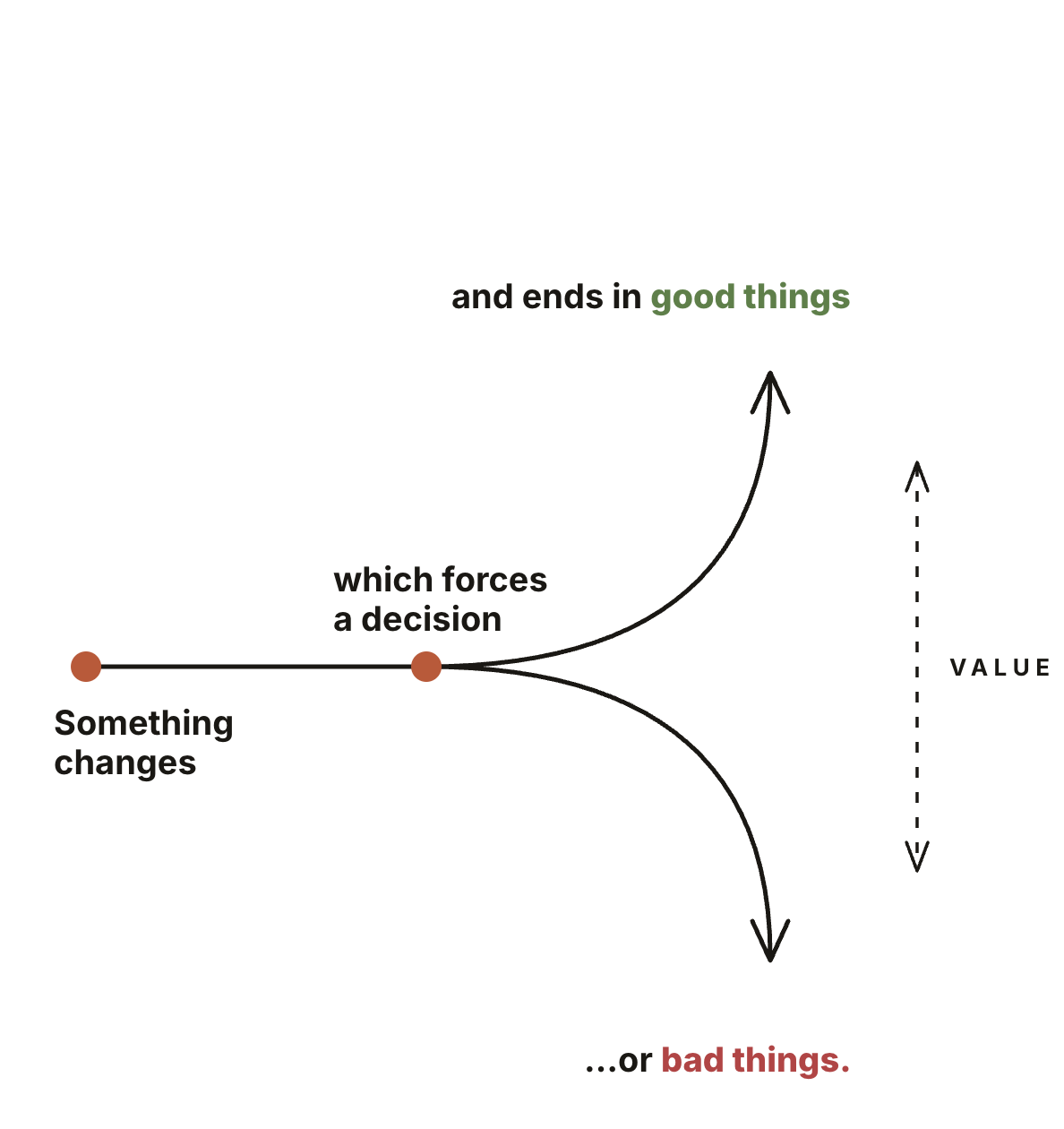
1. What's changing? This is the part AI is good at, so let it do the digging:
I'm building a sales point of view for [COMPANY]. Help me find a change worth building it around.
I am NOT looking for small, operational changes like a new tool, a reorg, or a routine exec hire. I'm looking for the kind of change that's about to slam into the side of their ship: a shift in their market, their buyer, their business model, or their cost structure that a senior leader is either (a) struggling to even name, or (b) can name, but hasn't figured out how to respond to yet.
Run two passes:
1. Market level: what's structurally changing in [COMPANY]'s industry, or in how their customers buy, right now? 2. Account level: using their last four earnings calls, latest 10-K, recent exec interviews, job postings, and news, where is [COMPANY] specifically exposed to or already moving on that change? Quote the exact words their executives use.
Give me ten candidate changes, ranked by how high the stakes are for a senior leader there. For each, tell me whether it's (a) or (b) above, and cite a source.
Then do the part it can't: pick the one change that's a rogue wave.
- Too small, throw it out: "They're migrating to a new CRM." "They opened a second office."
- Rogue wave, keep it: "Their whole motion was built to sell to IT, but the budget for their category has quietly moved to line-of-business buyers who've never heard of them."
The clearest sign a change is real is a contradiction inside the account, in the gap between what the company says it wants and what its behavior shows. They say growth is the priority, but every hire this year was in support. They say the project is urgent, but it's been "next quarter" for three quarters running. A model can't see that gap unless you feed it what you noticed, so let it gather the raw material (the 10-K, the org chart, the hiring pattern, and the last four earnings calls), and you supply the nerve to say it out loud.
2. What could you give them? Find an offer with standalone value, whether or not they ever buy from you, the kind of thing that gets them thinking, if they did this before we're even a customer, imagine what we'd be doing together once we are. Start by writing down, on your own and without AI, three to five things you know that others don't, but they'd value if they did. Maybe your company built benchmarks from proprietary data. Or maybe your edge isn't the data, it's the reps: you've personally watched forty companies make the exact move this account is about to make, so you know the order things break in. Then let AI turn those into a menu:
Here are a few things I uniquely know or have access to, that most people selling to my customers don't:
[paste your 3–5, in your own words]
Turn each one into a tangible offer I could actually deliver to an executive: a specific artifact, teardown, benchmark, or analysis with standalone value to them, whether or not they ever buy from me. For each:
- Name it the way I'd say it on a call ("here's a that shows you "). - Say what I'd have to build or pull to deliver it, and roughly how long it takes. - Name the title who'd care most, and the one question they're privately asking themselves that it answers. - Rate how hard it'd be for a competitor to copy without my specific edge. Cut any that are easy to copy.
Give me the survivors as a ranked menu, best value-for-effort first, so I've got a few in my back pocket to match to whatever's changing in a given account.
"An ROI calculator for our product" is a pitch in disguise. "We ran your ten best-selling sofas through fifty real Manhattan apartment photos, and found the three that lose the most carts to the imagination gap" is something they'd want even if they never bought a thing.
3. Could they argue with it? Write this sentence yourself, because the value of a point of view is that you planted it and you're standing behind it:
"I know ________, and you need to know that too, because it's going to change how you respond to ________."
Then hold it up to the test: could this executive actually disagree with it?
- The weather, rewrite it: "I know AI is changing sales, and you need to know that too, because it's going to change how you respond to the market."
- Pointy, use it: "I know the shopper who built your business is aging out, and the one replacing them will never walk into a big box, and you need to know that, because the real estate that's been your single greatest asset is about to become your biggest liability."
If you want to spar with it before you're live, hand it to AI as the skeptic:
Play a skeptical, time-poor [TITLE] at [COMPANY]. I'm going to give you my point of view. React the way that real executive would: tell me where it's generic, where I'm wrong, where I'm telling you something you already know, and what would actually make you lean in. Don't be polite.
My point of view: [paste your sentence]
Take what's useful and ignore the rest, since it's a sparring partner, not the judge.
4. Confirmed, or corrected? Say it early on your next call, and then do the hard part, which is stop talking. Either they say "That's exactly right," and you lean all the way in, or they say "That's not quite it, but..." and hand you the real problem for free. Write down which one you got and the exact words they used back, then rewrite your sentence before the next deal.
What does a sales point of view template look like?
The template I use keeps everything on one page:
- A soundbite at the top. Because of a major shift in the customer's business or market, now's the time for them to take the strategy you uniquely enable, so they avoid the negative outcomes while getting the positive ones. (That's the same change, approach, upside, and downside structure as the 4-sentence soundbite.)
- The strategic vision. The three-year, board-level vision you're guiding them toward, what's changing in their environment to create greater need for you, and one more unique insight into the account.
- Current state and future state. Their situation and why it's getting worse, the negative outcomes it's causing, the future you're describing, and the measurable outcomes by a target date.
- The offer and the claim. What you could give them, the "I know..." sentence, and a line for what they said back.
Once it's confirmed, it becomes page one of your account plan. And if you want to find exactly where the change hits their numbers, draw their driver tree.
Your move this week
Before your next meaningful call, write the "I know..." sentence for that account, specific enough that the buyer could disagree with it. Then say it early, and when they push back, don't defend it. Get curious, because the correction is the prize.
Plant one a day for two weeks. You'll be wrong a lot at first, and that's the point.