Split the Future Two Ways: How to Make Doing Nothing Feel Expensive
Left alone, buyers almost never move. Show them two futures side by side, end on the cost of doing nothing, and shrink the first step until it’s easy to say yes.
By Nate Nasralla11 min read
The short answer
To beat the status quo in sales, show your buyer two futures side by side: what happens if they act, and what happens if they don’t. Value only shows up in contrast, so move back and forth between the two until the gap is hard to ignore, end on the cost of doing nothing, and make the first step small and safe enough to say yes to this month.
On this page
Questions answered
Frequently asked questions
Why do buyers choose the status quo?
Because staying put is the safest decision inside most companies. Every change carries a cost, a risk, and an owner who takes the blame if it goes wrong, while renewing what worked last year gets nobody fired. Buyers also can’t judge value in isolation, so if they only see the upside of changing, with nothing to compare it to, the status quo wins by default.
What is a sparkline in sales storytelling?
It’s Nancy Duarte’s chart of how great talks move. The story starts at what is, the way things are today, then swings back and forth between what is and what could be, the future if the audience acts. In a sales conversation, that means pairing every description of the buyer’s current state with the better future, and ending on a specific next step.
Should a sales message end on the upside or the downside?
When a message has to travel without you, end on the downside: the cost of doing nothing. Upside is a maybe amount somewhere in the future, while the cost of inaction is a certain amount the buyer is losing today, and that’s what competes with “let’s revisit next quarter.” Then make the first step small and safe, so ending on the downside doesn’t freeze them.
Simplify complex sales: get the latest frameworks.
Short, practical frameworks for executive messaging, business cases, multithreading, and sales enablement.
For decades, most people got their disability and life insurance the same way: you start a new job, HR sends you a link to a benefits portal, and you check a few boxes. It works because of the pool. A company with 10,000 employees can offer a group plan because the risk spreads across all of them.
But the person who drove your last Uber has no HR department, and if they throw out their back and can't drive for six weeks, the income just stops. By 2019, 35% of the US workforce was doing some kind of freelance work.
Which was a pretty big problem for Unum, one of the biggest names in workplace benefits, because their entire business ran through employers. Every worker who traded a W-2 for a 1099 was walking out of the pool.
At the time, my team sold a data platform that tracked emerging companies (think Crunchbase) to innovation teams inside large enterprises, with advisory services wrapped around it. Unum was a natural fit, except they'd already signed on as a partner with Plug and Play, a Silicon Valley platform that connects big companies with startups. On paper, we were a second subscription to the same thing.
So we didn't lead with the list. We led with what was at stake.
With the team leading that work on their side, we laid out a thesis: as work shifted to the gig economy, a massive new market was opening up, and Unum's product lines weren't built for it. Then we split the future two ways. In one, Unum builds a shared pool of benefits for the new economy, and writes the rules everyone else follows. In the other, their core market shrinks a little more every year, while someone else writes the rules for the next one.
But the moment it clicked came after the meeting, when we made three intros to tech companies that could help their team build it. Nobody asked us to, and there was no contract, just three conversations as proof we could help get them there. We signed a multiyear deal.
Plug and Play could show Unum what was out there. We showed them two futures side by side, and a first step small enough to take right away. That's the skill here, and by the end, you'll have a drill to check whether your own calls have it.
Why does "let's revisit next quarter" win so often?
Because staying put is the safest decision in any company. Nobody gets fired for renewing the plan that worked last year, and every change comes with a cost, a risk, and somebody who has to own it if it goes sideways. Which means "good" isn't enough to get someone moving.
Quick question: is 65 degrees warm?
If you just walked in from a January afternoon in Minneapolis, 65 feels like a beach day. If you walked in from a July afternoon in Phoenix, you're reaching for a sweater. Same 65 degrees, completely different reaction, because your brain doesn't really measure temperature, it measures the difference.
Value works the same way. As I wrote in Brief & Brilliant, we can't see value in isolation, only next to something else:
Value = good outcomes minus bad outcomes
So if you only show a buyer the good future, it's 65 degrees with no idea where they walked in from. The most persuasive people in the world put the better future right next to the present, back and forth, until the gap is impossible to ignore, and Nancy Duarte drew a picture of exactly what that looks like.
What do the best talks have in common?
Duarte's firm designed the slideshow behind Al Gore's An Inconvenient Truth, and at some point she started asking why a few talks move people while most just inform them. So she went back through hundreds of famous speeches, charted them for her book Resonate, and found the same shape over and over. Every great talk moves between two places:
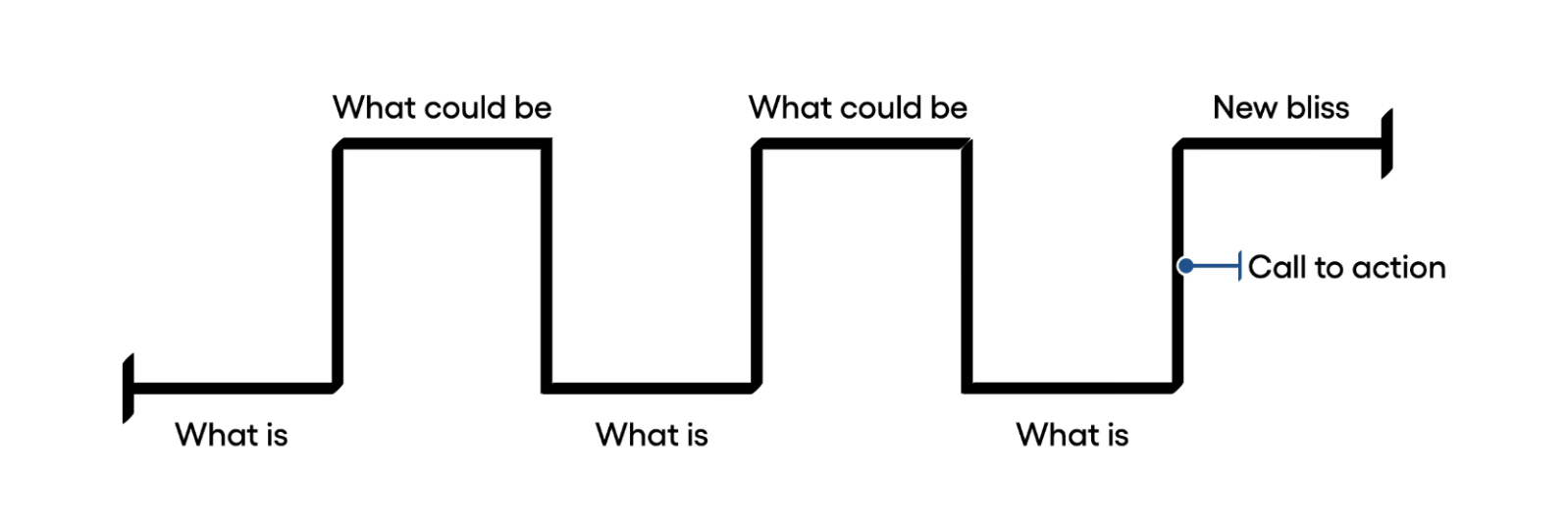
What is: the status quo, the way things are today.
What could be: the future, if the audience acts on the idea.
She calls the chart a sparkline. It starts at what is, and a first turning point, the "call to adventure," shows the gap between the two. The middle swings back and forth, a second turning point, the "call to action," tells the audience what to do, and it ends on what she calls "the new bliss," the world after the idea's been adopted.
Steve Jobs' 2007 iPhone launch runs this shape. He put up four smartphones he called "the usual suspects": a Motorola Q, a BlackBerry, a Palm Treo, and a Nokia E62, each with a plastic keyboard bolted on whether you needed those buttons or not. That's what is. Then he swung up to what could be: one big screen, and your finger. Duarte even charted his audience, with a tick mark for every laugh and every round of applause. (Hold onto that, you'll use it in the drill below.)
Her rule for all of it: "you need to make that gap as big as possible."
Now, follow me here: why not paint the bad picture once, then the good one, and be done with it? Duarte's answer is a sailing one. People resist new ideas, and when you sail into the wind, you can't go straight at it, so you tack back and forth, catching the resistance in your sails. Set them right, she says, and a boat can move faster than the wind itself.
What happens when the "what is" is them?
Remember the Nokia E62 on the what-is side of Jobs' line? Four years later, Nokia's own CEO, Stephen Elop, sent his executives a memo about a man on a burning oil platform with seconds to decide whether to jump into freezing water, then turned it on his own company: "Nokia, our platform is burning."
Every large enterprise you work with has a little Nokia in them. The status quo you're describing is usually something someone in that room built or signed off on, so it's easier to put their heads in the sand (the Ostrich Effect) than admit the platform's on fire. So your job is to bring them to the ledge, and show them both futures clearly enough to jump.
How do you fit both futures into four sentences?
The four-sentence soundbite from Brief & Brilliant turns out to be a sparkline, compressed:
Because of [ a large, unaddressed change in the customer's world ]: now's the time to [ respond with a specific approach you uniquely enable ], by [ a certain date ].
If we do, we'll create [ good outcomes that align with our priority ]. If we don't, [ bad outcomes will continue, and get worse ].
Read it again with Duarte's line in mind:
The change is what is, and the call to adventure.
"Now's the time" is the call to action.
"If we do" is what could be.
"If we don't" takes you back below the line, and lower than where you started.
It's small enough for your champion to repeat in a room you're not in (I broke down how to write each sentence in Selling in Soundbites).
But notice where it ends. Duarte ends a keynote on the new bliss, and on stage, that's exactly right. Your soundbite gets forwarded into a room where the default is doing nothing, so it ends on the one sentence that makes doing nothing feel expensive: ROI is a maybe amount, somewhere off in the future, while the cost of inaction is a certain amount they're losing today.
For Unum, it sounded something like this:
Because work is shifting from corporate jobs to the gig economy, a massive new market is opening up, and our product lines weren't built for it. Now's the time to build a shared pool of benefits for the new economy, the way group plans pooled risk for the old one, with a first product in market by the end of next year.
If we do, we set the precedent for the whole market, not just our own products. If we don't, our core market shrinks every time a worker trades a W-2 for a 1099, and someone else writes the rules for the next one.
A list of startups gives an innovation team homework. That soundbite gave our champion a story to tell, and once the deal needs it in writing, the same two futures sit at the top of your 1-page business case.
"So the play is to scare them?"
Paint the platform as hot as you can, and wait for them to jump? Not quite.
Matt Dixon and Ted McKenna studied more than 2.5 million sales conversations for The JOLT Effect and found that 40% to 60% of deals end in no decision. But more than half of those losses came from indecision, not a preference for the status quo. The buyer wanted to move, and froze, afraid of getting the decision wrong, so turning up the heat just piles more weight onto a decision that already feels too heavy to lift.
So there are two gaps here, and you push them in opposite directions. I put it this way in Selling With:
Contrasting outcomes is a measure of value.
Contrasting process is a measure of change.
And buyers don't love change, because change is risky and hard. So widen the gap between the two futures as far as the facts allow, and shrink the step from today to tomorrow until it's small and safe.
Which is why Unum clicked after the meeting, not during it. The future we'd painted was massive, but the first step toward it was three intros they could take without signing or risking anything, and they were worth something whether or not Unum ever bought from us: what Jordan Crawford calls a "permissionless value prop," and the same kind of offer you build into a sales point of view.
The biggest version of what could be, with the smallest, safest step toward it: that's a call to action a buyer can say yes to.
What shape are your sales calls?
Most of us remember how our calls felt, which isn't the same as how they went. So pull up a recording of a recent call on a live deal, and grab a pencil.
1. Draw the call
Turn a blank sheet sideways and draw a light line across the middle. That's your neutral baseline, for logistics, small talk, and features with no outcome attached. Press play and drag your pencil left to right as the call goes (about an inch every three minutes on a 30-minute call):
Move up when someone describes what could be: a goal they'd love to hit, or a good outcome.
Move down when someone describes what is: a cost, a risk, or something about to get worse.
The more specific it is, the further you move: "things could be better" barely lifts the pencil, and "we'd hit our renewal target a quarter early" sends it up an inch.
Then make a tick mark every time the buyer reacts, like when they say "say more," volunteer a number, push back, or mention someone else who needs to hear this. That's Duarte's laughs and applause, sales edition.
2. Read the shape
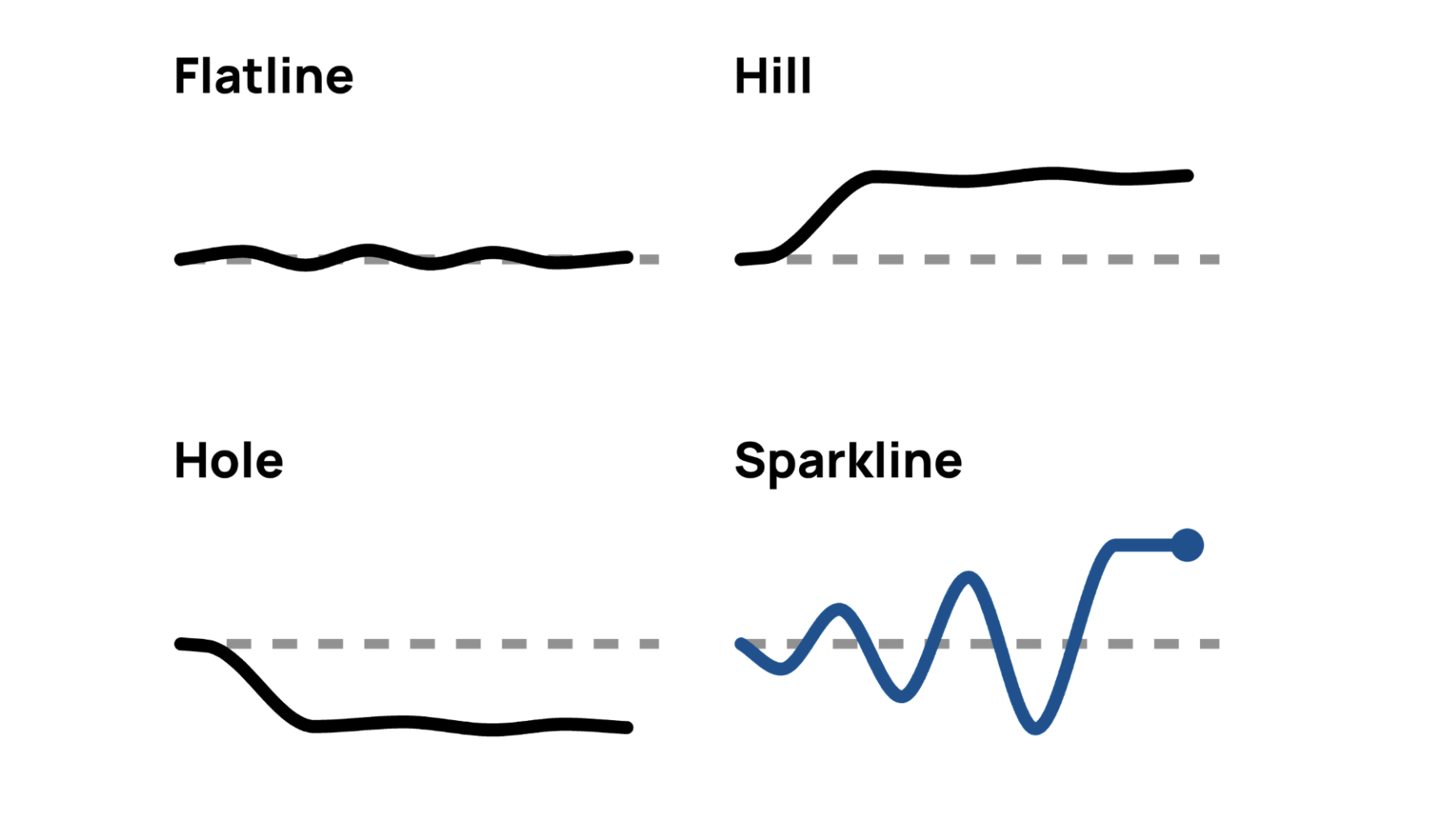
Most calls look like one of four:
The flatline barely leaves the baseline: a pleasant tour of features and next steps, with nothing at stake.
The hill goes up and stays up: all upside, where nothing bad happens if they wait. It feels great, then stalls, because maybe money rarely beats doing nothing.
The hole goes down and stays down: a tour of everything that's broken, which is where buyers get defensive or go quiet.
The sparkline swings back and forth, wider as the call goes on, and ends above the line on a specific next step.
Then check your tick marks: where they cluster, and whether the call ended above or below the line. On the best calls, the buyer moves the line as much as you do, because they're the one describing their own two futures.
3. Let AI test your read
Only after you've drawn it, hand the transcript to your favorite robot:
Here's a transcript of a sales call between me ([ YOUR NAME ]) and [ BUYER NAME, TITLE ] at [ COMPANY ].
Go through it turn by turn, and label every turn as one of three things: 1. WHAT IS: the current state, a cost, a risk, or something getting worse. 2. WHAT COULD BE: a better future, a goal, or a good outcome. 3. NEUTRAL: logistics, small talk, or features with no outcome attached.
Score each turn from -3 to +3, based on how specific and intense it is. A number, a name, or a date counts for more than a general statement.
Then plot it as a line chart across the length of the call, with a different color for each speaker, and mark every moment the buyer reacted: a question, pushback, a number they volunteered, or a request to loop someone else in.
Finally, tell me where the biggest swings happened, who caused them, and where the call ended relative to the baseline. Be direct. Don't grade on a curve.
[ PASTE TRANSCRIPT ]
Where you and the AI disagree is where the learning is:
A big swing with no tick mark: you said something that sounded big, and the buyer didn't care.
A tick mark it scored neutral: you caught something a transcript flattens out, like a long pause, or "when we roll this out" quietly turning into "if." That part's yours.
4. Split the future two ways
Now write the four-sentence soundbite for this deal, by hand:
Weak, could go to any company:"Because the market's changing, now's the time to modernize your benefits platform. If you do, you'll see efficiency gains. If you don't, you'll fall behind." The change is vague, the upside is a process improvement, and "fall behind" is a shade of gray.
Strong, both futures in their own numbers: picture the makeup brand from the driver tree article, whose store counters closed in 2020. "Because your counters closed and online is now carrying the business, now's the time to put a try-on counter in every shopper's pocket, starting with your best-selling shades, live before the holiday season. If we do, makeup shoppers who bounce today buy online, right alongside the skin care they're already buying. If we don't, makeup keeps sliding from that 18% drop, and you keep paying for traffic that leaves."
After your first swing, bring your robot back in to play the executive who'll hear it secondhand:
Here's the four-sentence soundbite I wrote for [ COMPANY ], along with my notes from the call and the driver tree I built for them:
[ PASTE SOUNDBITE, CALL NOTES, AND DRIVER TREE ]
Play [ EXECUTIVE ], who'll hear this secondhand from [ CHAMPION ]. Then tell me: 1. Which sentence is the weakest, and why? 2. Is the gap between sentences 3 and 4 big enough to make doing nothing feel expensive? If not, use their own numbers to widen it. 3. Is the step in sentence 2 small and safe enough to say yes to this month? If not, give me three smaller first steps that still prove we can help, like an intro, a teardown, or a benchmark.
Don't rewrite the whole thing. Show me the specific edits, and why.
5. Run the second rep
Plan one deliberate swing for your next call: take them below the line with their own numbers, back above it with what could be, and end on the smallest, safest next step you can offer.
Then draw that call too, and lay the two drawings side by side. Did the swings get wider, and did the buyer start moving the line?
The gap between those two drawings is your slope, how fast you're improving. And while results reset every quarter, skills are sticky, so you get to build on them.