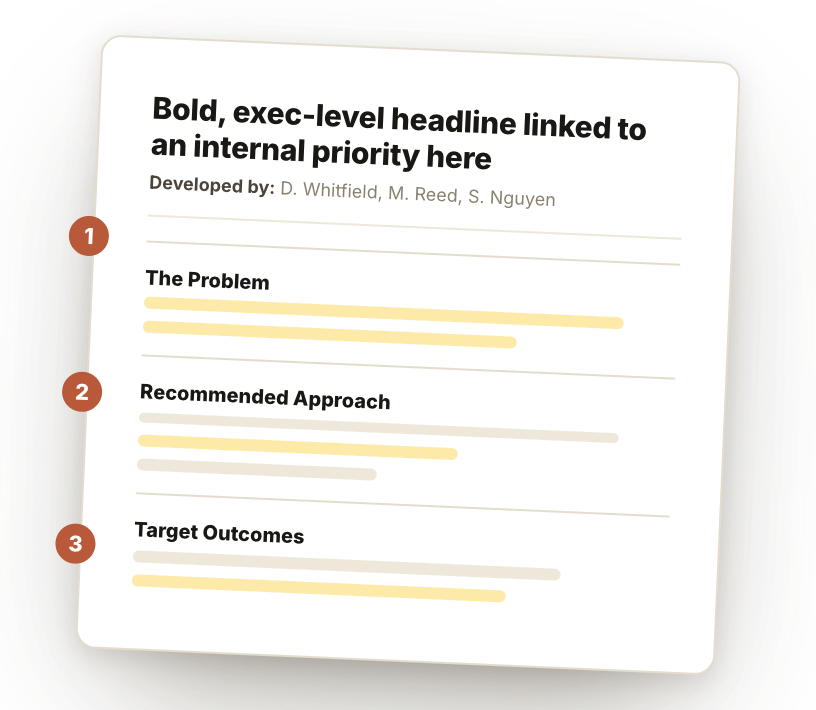
Why do so many demos turn into a long commercial?
"Nate, I got it. You can stop selling me now," the SVP said flatly.
Whoops. I was halfway through demoing our platform when he cut me off. We had just hired a new rep, and the SVP caught me showing off. I think I wanted our new hire to think his new boss was a smart guy. Which gave me a major case of myopia: I was too focused on how I sounded while talking about the product, instead of what the SVP was searching for in a partner, or what our champions had told us.
That's a champion's worst nightmare, by the way. They spend their chips to bring their team together, their boss included, and it turns into a really long commercial.
Most sales demo preparation checklists cover the environment, the script, and the logins, which all matter. But demos also become a copout for thoughtful conversation. When you're not sure how to structure a productive meeting, or what the next best question is to advance the deal, you find safety in your screen. There's always more to show, and your product is familiar territory.
So before you open the product, fill in a pre-demo brief: six short sections, starting with the decision the demo has to support. (If you've already started a business case with your champion, it's the best place to pull from, since it already holds their problem and their outcomes in their words.)
What goes in a pre-demo brief?
1. The decision, and the evidence you'll look for. Three sentences:
We need to enable [next decision & buying behavior] to keep our deal on track.
If we see [evidence] by the end of the meeting, the conversation was successful.
We also need to ensure [key contact] feels [emotion] after, based on [context].
2. The current state, and why now. The problem goes in the buyer's terms:
Despite trying [failed solutions], they still can't reach [positive outcomes] because of [problem / root cause], which is costing them [negative outcomes].
Then the why-now line: which executive is pushing for which strategic priority, the internal project name behind it, and the compelling event they're working toward.
3. The future state, and the alternatives. List the one or two executive KPIs the demo has to move, today's number for each, and the target by a date. Then write down why you'd lose (a competitor, an in-house build, or a priority that pulls the team's focus elsewhere).
4. Who's attending, and who leads what. Now list every name on the invite, and next to each one, the key objection you need to resolve for them. Then split the agenda, so nobody's guessing who talks when:
- Intro and objective: AE
- Framing and context: AE and champion
- Demo: Sales engineer
- Discussion: AE, your own executive, and the champion
- Next steps: AE
- Follow-up: AE and champion
5. Two focus areas. For each one, run the same arc: frame the root cause, recap their current state, agree on the approach, show one or two core features, picture the outcome together, and confirm the value in the conversation.
6. The ask, and the follow-up. Name the commitment you're asking for before the call, as the next rung up from where the deal sits today. Commitments climb from time with a key person, to data, to an introduction, to a calendar hold for planning, to a group or executive presentation, to approval, and the ask should cost them something small (a commitment that costs nothing tells you nothing). After the call, write down what each person confirmed, challenged, or left open, and who owns the follow-up.
How do you choose what to show in each focus area?
Start by confirming the cost of their current process. Then find a specific, focused scenario from it, demo how that scenario works with your product, and stop there. Call out the outcome the change creates, and talk through their concerns about it.
The reason to keep it that tight: contrasting current versus future outcomes is a measure of value, while contrasting current versus future process is a measure of change. Prospects don't like change, because it's risky and hard. So don't do this:
Don't say: "Excel spreadsheets are prone to errors and take up too much time with manual data entry. We'll replace those spreadsheets to automate your quarterly forecasting." Then proceed to whip through a bunch of colorful dashboards you can build out. Instead, say: "Forecasting key accounts is subjective and can drastically swing a forecast. Let's start by comparing our machine-generated forecast with your Excel forecast, for the top 20 key accounts only."
See the difference? Change feels far more manageable when it's contained.
And the shape of the demo changes with who's in the room:
- Below the line, run a reverse demo. It's magic for daily users. Find the one or two workflows they spend 80% of their week in, then ask before you open your product: "You mentioned [workflow] is what you spend 80% of your week on, yet you're not able to [your product's differentiator]. Would you be open to sharing your screen and walking me through what this looks like for you?" Then show that same workflow in your product.
- Above the line, begin at the end. Show the "after" state in the first 15 seconds, with just enough product to create confidence you can deliver. Keep a few scenes staged in separate windows so you're clicking once instead of navigating, and if they want more detail on how something works, they'll ask.
What does a focus area look like on paper?
My own planning sheet has an example from selling to sales teams. One focus area reads like this:
- Customer problem: Slowing revenue growth is falling below plan.
- Root cause: We can't break into the enterprise segment.
- Negative impact: Our average contract value stays in 5 figures, we struggle to win large logos with 6 & 7 figure deals.
- Required capability: Develop champions who can help navigate complex buying groups and long cycles.
- Unique differentiator: [Feature] Collaborative process that builds greater sense of ownership and tests for commitment.
- Desired outcome: 40% of net-new revenue in the next two years driven by 10% of our new accounts.
- Metrics: Growth rate and average contract value
One differentiator, tied to the root cause, and an outcome written in the metrics the buyer already tracks. The demo for this focus area only has to show enough of the product to make that differentiator believable.
"We know our product. Why do we need a brief?"
Because the product is the part that doesn't change from deal to deal. What changes is which two scenarios matter to this team, which attendee is worried about the rollout, how your key contact needs to feel walking out, and which commitment you're asking for. Your SE can run the product in their sleep, but they can't know any of that unless someone writes it down.
Your move this week
- Take your next scheduled demo and write the three sentences in section one.
- List every attendee and the one objection you need to resolve for each of them.
- Cut the demo down to two focus areas, and coordinate with your champion before the call on which parts they'll lead.