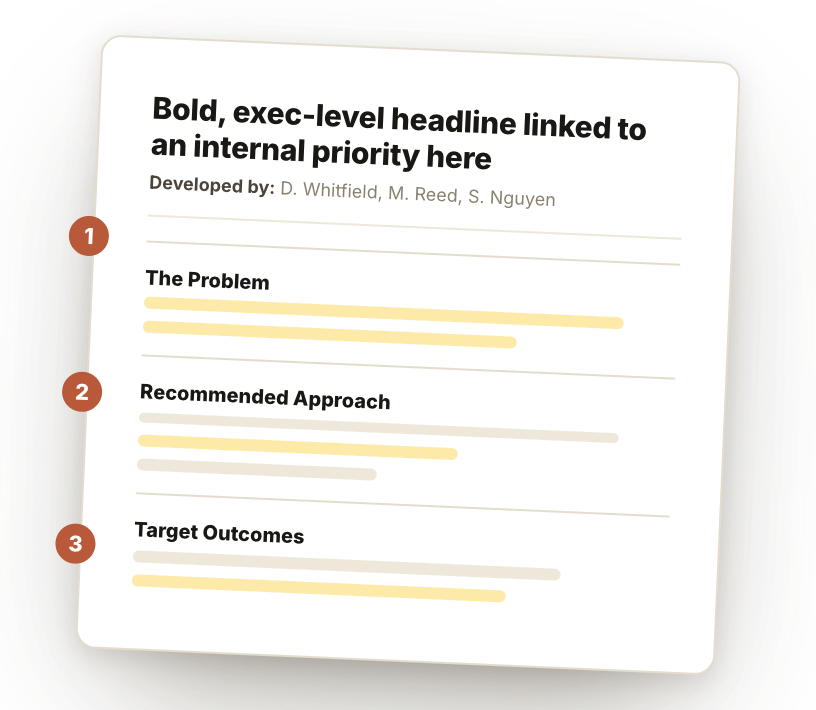
How can a deal feel great and still be missing half its case?
Five demos, a dozen people met, 20 emails, and every MEDDICC field filled in. Most reps would call that a sure thing, right up until the deal dies in a hallway-length conversation they were never part of.
All that activity was real. It just doesn't tell you what the buyer has agreed to, and the business case does, because it shows what's on the page in the buyer's own words and what's still blank.
If you've read The 1-Page Business Case, you know the case gets built with your champion from the first call, and that it should get stronger as the deal moves. This piece is about what comes next: scoring it, so the gaps in a deal show up on the page before they show up in your forecast.
How do you score a business case?
Score each of the five sections from 1 to 5. Here's what a 5 looks like for each one:
- Priority-driven headline: Tied to an existing initiative, timebound to a critical event date, with a named executive sponsor.
- Problem statement: A high-cost problem measured with customer-validated metrics, agreed on by multiple people, framed at more than one level of impact, and getting worse with time.
- Recommended approach: Required capabilities line up with your differentiators, signed off by everyone from end users through security and IT, with alternatives openly discussed and ruled out.
- Target outcomes: Specific metrics with a customer-validated before and after, scenarios labeled, and language that builds emotion beyond "ROI."
- Required investment: Budget signed off by the budget owner and procurement, people reserved for rollout, go-live anchored to a customer-provided critical event, and backdated steps to get there.
Add up the five scores and divide by 25. That's your readiness percentage.
Two rules keep the scoring honest:
- Score the highest level the page fully meets. If a section meets some but not all of a level, it gets the level below.
- Only count what the buyer confirmed. A number your SE estimated isn't customer-validated until the customer agrees with it, and a sponsor isn't identified until someone on their side names them.
Here's how one section climbs, so you can see what each point means. A problem statement that's vague with no numbers is a 1. Add a few metrics without confirming who's affected and it's a 2. Get some metrics in but not customer-validated, and it's a 3. Validate the metrics with the customer and identify who's impacted, still without full agreement, and it's a 4. Get the validated cost agreed by several people, framed at more than one level, and getting worse with time, and it's a 5.
What does a low score tell you about the deal?
This is where the scorecard earns its keep. Each low section points at a specific gap in the deal, and each gap has a move that closes it:
- Headline: What it usually means in the deal: No executive sponsor and no date, so there's no reason for this to close this quarter; The move: Ask your champion whose top-three priority list this sits on this year, and get a name
- Problem statement: What it usually means in the deal: One person's opinion, with no number attached; The move: Send your champion a tiny, specific request for the one metric that measures the problem
- Recommended approach: What it usually means in the deal: Alternatives are still open, and security or IT haven't weighed in; The move: Send the required capabilities to security, IT, and procurement as a neutral checklist before the vendor conversation
- Target outcomes: What it usually means in the deal: The numbers are your estimates, so they'll get negotiated away; The move: Take your three KPIs to the economic buyer and ask, "Are these the numbers your board would care about, and are our baselines right?"
- Required investment: What it usually means in the deal: No budget owner, no procurement contact, and no critical event behind the date; The move: Find the date go-live has to beat, then ask your champion to introduce procurement
That data request in the second row is the move that does the most work, by the way. Pulling the number usually means your champion has to loop in whoever owns it, which is multithreading for free.
So the gap between today's score and a 5 is your deal plan. A rep who thinks a deal is "in great shape" and scores a 2 on the problem statement has just found their next three conversations.
How good does a business case need to be?
Not perfect. At Fluint, we had our model score the messaging in nearly 45,000 deals against a version of this rubric, then compared those scores with how the deals ended.
Deals that scored around 74% (a "C" on a grade-school scale) won about 65% of the time. Below that line, the win rate dropped to 12%. The bar sat a little higher for new logos, at about 79%, and a little lower for expansion deals, at about 70%.
You need a C, not an A+. And you won't start anywhere near a C, because the first draft after a discovery call is mostly blanks. So set a minimum score for each stage, and expect it to climb:
- Stage 1: A draft exists, built from your first conversations
- Stage 2: 2 / 5 (40%)
- Stage 3: 3 / 5 (60%)
- Stage 4: 3.5 / 5 (70%)
- Stage 5: 4 / 5 (80%)
Adjust the numbers to your own stages. If a deal's case doesn't meet the minimum for its stage, there's work to do before it moves forward.
How do you use the scores in a deal review?
Score every open deal, and the conversation in your forecast call changes. A manager can stop asking for more activity and coach the lowest-scoring section on each deal, which takes a few minutes per deal.
It also makes the forecast honest in both directions. One enterprise team I advise compared their Q4 deals that met their business case standard with the ones that didn't. The deals at standard had a decision-maker involved 73% of the time, versus 24%. They closed-won in 114 days, versus 152. And the ones that lost, lost in 100 days, versus 198.
Which is the part forecasts need most. A deal that's going to lose is a lot cheaper to find in the third month than in the seventh.
Look across a rep's deals and you'll see something else, too. If one rep's cases keep scoring low on target outcomes, that's a skills gap, and now you know exactly what to coach. I'll go deeper on running the review itself in the 60-Second Deal Review.
"Isn't this just grading our own homework?"
It can be, which is why the second scoring rule matters so much. A seller who scores their own case will round up, every time. So build the checks into the page itself:
- Score only what's on the page. If the metric, the sponsor, or the sign-off isn't written down in the buyer's words, it doesn't count yet.
- Have someone else score it. Your manager, or better yet your champion. "Here's how I'd score where we are. What would you change?" is a discovery question disguised as a review.
- Watch the trend. A case that moved from 2 to 3 since last week tells you more than a case that's sat at 3.5 for a month.
Your move this week
- Score three open deals at different stages with the scorecard below. Be honest: "customer-validated" means the customer said it.
- Compare each one to its stage minimum.
- On your biggest deal, find the lowest-scoring section and run the matching move from the table above.
- Bring the score to your next deal review, instead of the play-by-play.
Get the framework
The 1-Page Business Case Scorecard. Get the 1-Page Business Case Scorecard, score your own deals against it, and see the minimum for each stage in your pipeline.
Frequently asked questions
How do you score a sales business case?
Rate each of the five sections (headline, problem statement, recommended approach, target outcomes, and required investment) from 1 to 5 against a rubric, add them up, and divide by 25 for a readiness percentage. Score the highest level each section fully meets, and only count what the buyer has confirmed.
What's a good business case score?
Across nearly 45,000 deals, cases that scored around 74% won about 65% of the time, and cases below that won about 12%. Early in a deal, expect much lower. Set a minimum for each stage, around 40% at stage two and climbing to about 80% by the final stage, and treat any deal below its minimum as unfinished.
How do you use a business case in a deal review?
Bring the score to the review. Look at the lowest-scoring section, name the gap it points to (no sponsor, no number, open alternatives, unvalidated outcomes, or no budget owner), and agree on the one move that closes it before the next review.