Why do deal reviews take an hour and still miss the risk?
In just 60 seconds, I can tell you if a deal's going to get a decision or get deleted. Which is roughly 59 minutes faster than the typical deal review.
You've probably sat through the typical one. The VP says, "Walk me through this one, it's big for our quarter," and the rep starts on the play-by-play. The manager adds something to sound on top of it, the rep goes into more detail, and the VP drifts back to their inbox until they finally look up and ask, "Okay, so when are we meeting their exec?" Then somebody notices it's been an hour.
When I say it should take a minute, the pushback is usually some version of, "But you don't know our product! You don't know our business!" Exactly. Neither does the executive your champion is trying to win over, and if what they hear doesn't hook them in the first minute, they'll move on.
What goes in a 60-second deal review?
Two parts, plus links to the work behind them.
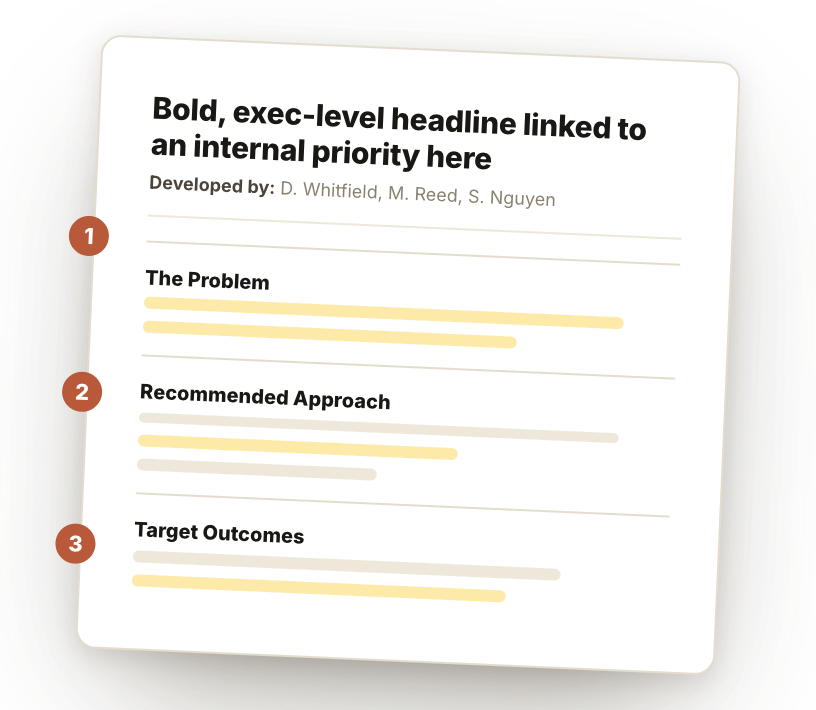
Part 1: the deal story, in three sentences. It pulls from your business case and reads a lot like a soundbite, opening on the change in the buyer's world:
[Company] is experiencing [significant change in their business / market], which means [negative outcomes].
[Executive] tasked [high-influence champion] with driving [a named project / strategic initiative] in response, with a target rollout date no later than [critical event].
Compared to [alternatives, deal threats], [Executive] confirmed [direct quote about our unique/competitive differentiator] will enable [direct quote about positive outcomes].
Part 2: seven evidence checks. Mark each one confirmed, inferred, or unknown, and note where the confirmed ones came from:
- A written problem statement, built with the buying team's own data.
- Direct comments or edits from them, confirming or correcting your point of view.
- At least three buying roles confirming your impact on a specific, exec-level metric.
- A buying-team executive funding a named project or internal initiative, with a team you can point to.
- A specific go-live date that, if missed, means a worse outcome for them.
- Written confirmation they've stopped exploring alternatives, because of a differentiator the other options don't have.
- The buying team sticking to a backdated set of milestones, and where they are against it.
Then link the full business case, its scorecard, and the mutual action plan, so anyone who wants to go deeper can.
How do you read a deal review in 60 seconds?
Pick up a few deal reviews and look at them side by side, and the differences jump out fast. Five reads cover the story:
- A big idea. Do the first and last sentences grab your attention? After a few lines, can you tell why this matters to the customer?
- Edits. How much did your champion change your draft between version one and version two? No redlines? No comments? Then it's still your storyline, and you're not there yet.
- Value. Is the gap between today and the future big enough to get above the director level? Workflow efficiency = a manager's problem. MQLs = a director's. Qualified pipeline = a VP's. CAC = the CMO's.
- Numbers, names, and dates. Are you using the customer's own data, a named initiative, and dates in a go-live plan?
- Unique language. Does it sound like your brand deck, or like your champion? It should be so specific it'd be weird to send to another account.
Once you've run a few, each of those reads takes 10 or 12 seconds, which is how the whole thing lands at about a minute. (Less time than it takes to brew a cup of French press, which I drank a lot of while writing about this.)
Doesn't a one-minute review cut corners?
It would, if the minute were doing the work. But the speed comes from the seven checks underneath the story, and every one of them points at something the buyer did. A written problem statement, three people confirming a metric, and a go-live date on their calendar all exist or they don't, and you can't talk your way into a confirmed.
Which means you forecast on what's confirmed. A deal in your commit column with several checks still marked unknown isn't a commit, whatever the CRM stage says, so move it back a stage. Moving a deal backward is never fun, I know, and it's also how you build a forecast leadership can trust.
And when the evidence isn't there yet, the review doesn't get shorter by skipping it. The unconfirmed checks become the agenda, and the time goes to the gap.
How should a manager coach from it?
Coach the earliest check that isn't confirmed. The seven checks follow the order a deal moves through its stages, so a gap early in the list usually explains the gaps after it. (If you've also scored the business case, the lowest-scoring section and the earliest unconfirmed check usually point at the same gap. When they don't, start with the earlier one.)
Each unconfirmed check points at one conversation:
- Written problem statement: "Which number measures this problem, and who on their team owns it?"
- Edits from the buyer: "When can you put the draft on screen with your champion and fill the gaps together?"
- Three roles confirming the metric: "Who else might this project impact that hasn't had a chance to weigh in yet?"
- Funded project: "Is there a project name and a team already working on this?"
- Go-live date: "If we weren't in the conversation, would they still need this solved by a specific date?"
- Alternatives ruled out: "What would they need to see in writing to stop exploring the other options?"
- Backdated milestones: "Can we backdate the steps from their date, and ask the champion what we missed?"
Then next week's review starts with whether that check moved to confirmed.
What does a scored deal look like?
Take Morgan, from a running example in Selling With (the scoring here is illustrative). She's a marketing manager at a high-growth startup, and her CMO, John, wants customer acquisition cost below $5K before the company raises its Series B. Her team would have to ramp content tenfold to get there, and they're already stretched.
The rep's three sentences:
- The company is heading into a Series B on a capital-efficient growth story, which means CAC has to drop below $5K with a content team that's already stretched.
- John tasked Morgan with driving "capital-efficient growth," with content ramped 10x by 12/31.
- Compared to ...
And that's where the rep stops, because nobody on the buyer's side has named the alternatives, let alone confirmed why this approach beats them. So the checks look like this:
- 1. Written problem statement with their data: Confirmed (Morgan shared CAC by channel)
- 2. Edits from the buyer: Confirmed (Morgan rewrote the headline)
- 3. Three roles confirming the metric: Unknown (just Morgan so far)
- 4. Funded project: Confirmed ("capital-efficient growth")
- 5. Go-live date with a consequence: Inferred (12/31, but nobody's said what happens if they miss it)
- 6. Alternatives ruled out in writing: Unknown
- 7. Backdated milestones: Unknown
So it's not a commit. The manager skips the play-by-play and coaches check #3: who else might this project impact that hasn't weighed in yet? Get two more people confirming the CAC problem, and the rest of the list has something to stand on.
Your move this week
- Write the three sentences for your biggest deal, and notice which one you can't finish.
- Mark the seven checks confirmed, inferred, or unknown, and write down the source for each confirmed one.
- Bring both to your next pipeline review, and ask your manager to coach the earliest unconfirmed check.