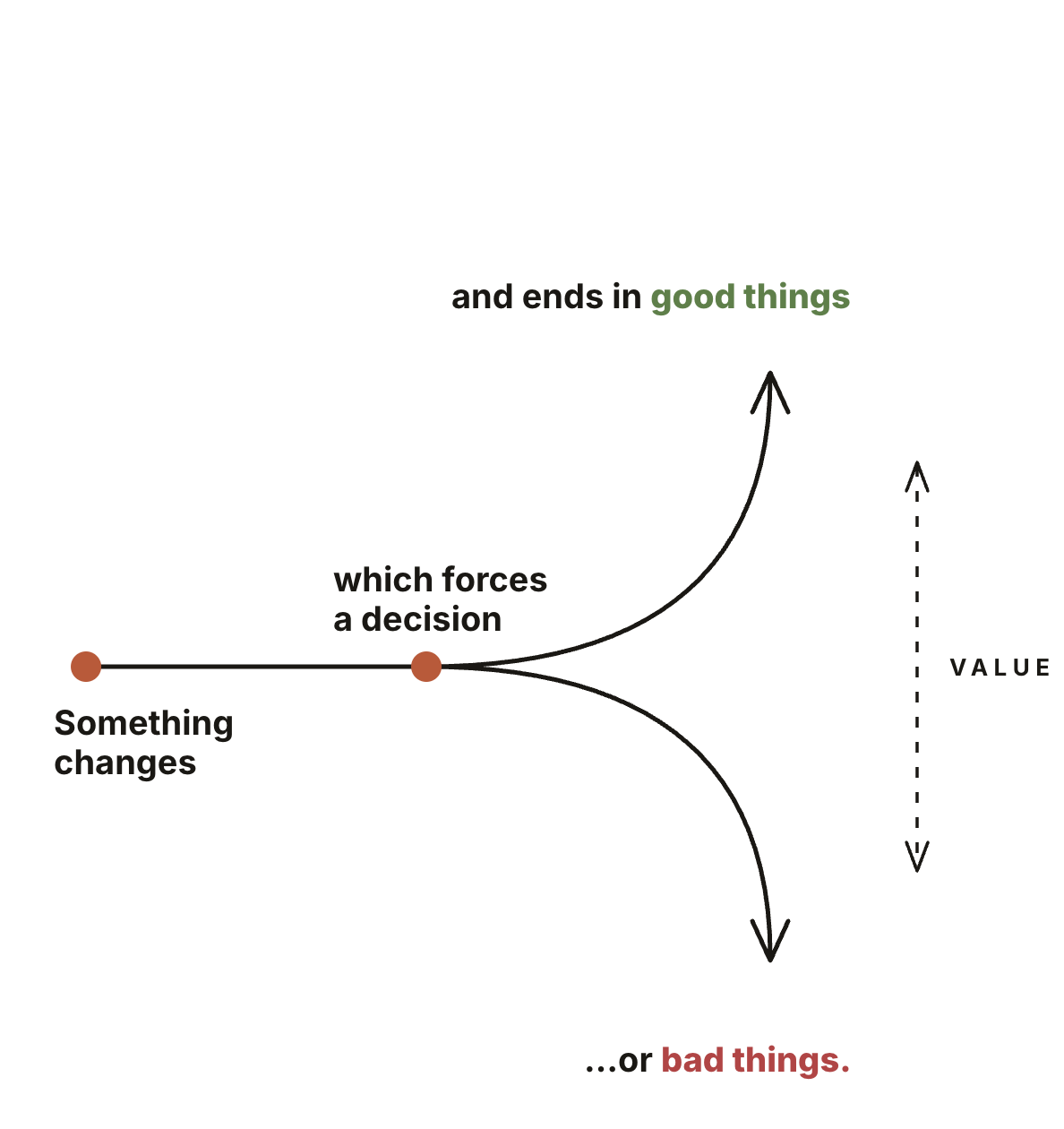
Why did an SVP think he'd already bought from us?
A few years ago, I was on a call with an SVP at a $5B cloud communications company, and he asked how long his team had engaged us for. Had they signed on for just this year, or set up something longer-term? I was a little confused, since neither was true. We were still working out if and how we'd structure our work together. Then he asked:
"You mean we haven't actually bought anything from you yet?"
He'd assumed we had some type of consulting agreement or services retainer in place, the kind his team would easily spend $100,000 on. But we'd been paid $0 to date. We were just running our sales process.
He assumed that because we brought him specific data backing a clear and direct recommendation. Plus, everything we presented was built with two internal champions, in their branding. And when an executive is surprised they're not paying you yet, a contract is soon to follow. The back half of your sales process melts like butter dropped into a cast-iron skillet.
We used one framework to guide our discovery early in that deal, and then to make our recommendation to the three SVPs we were working with. It's called SCR.
What is a consulting-style executive summary?
It's a short document that walks an executive through a decision in three parts: Situation, Complication, and Recommendation. It's consulting-style because SCR was originally adapted by McKinsey, to help simplify a complex decision for executives. When I wrote Brief & Brilliant, it was also the second most-used business case framework inside our platform at Fluint, right behind the 1-Page Business Case.
Each part answers one question:
- Situation: What's changing?
- Complication: Why do something now?
- Recommendation: What should we do?
What goes in a sales executive summary template?
The whole thing fits on one page, with your champion's name at the top:
Executive Summary: [ Describe the Business Priority ]
Developed by: [ Champion Name ], [ Key Deal Players ]
Situation
[ Company Name ] is experiencing [ a significant change in the customer's business model / industry ]. Over the past year, we've seen:
- Add a bulleted list here. - Include observations on the facts. - Plus circumstances surrounding the change.
At the same time, our goal is [ a future goal and the executive's vision for the company ].
Complication
However, [ describe the main problem standing in the way of the priority ].
Which we believe is being caused by:
- Root cause behind the problem. - Root cause behind the problem.
If left unchecked, it's likely to:
- Cost and negative impact to the business. - Cost and negative impact to the business.
Recommendation
Given [ unique requirements for a desired solution ], we believe the right approach is:
- Solution with a bulleted list of decision criteria. - Solution with a bulleted list of decision criteria.
Based on our research, we've found [ your product ], which has been proven to drive [ describe the positive outcomes ] for similar customers, using [ describe the product's differentiators ].
While [ describe the other, potential, alternative solutions being considered ] are also options, we believe this is the best path forward.
Situation. Start with the facts and the company's priorities, the things that are already known and accepted. Because if you don't get agreement here, the next two sections fall apart. So if you think the executive would push back on a bullet, rework it with your champion before you write anything else. Then close the section on the goal, in terms of where the executive wants to take the company.
Complication. This is why the situation needs action now, and why things will get much worse if nobody resolves it. Without enough tension here, decisions stall out. So list the root causes too, since they set up the recommendation that's coming, and put a cost on leaving it alone.
Recommendation. The specific course of action you're recommending. Which will always be more than just "buy my product." So in the solution bullets, include the dates, projects, and people invested, plus a short word on proof points and the outcomes after acting.
What does a finished one look like?
Now, back to that SVP. Here's the SCR message we used, with the share numbers left as X and Y:
Situation: Market share dropped from X% to Y% in the past 3 years, as usage from our core VoIP (Voice over IP) product declines while customer preferences shift.
Complication: We prioritized bringing real-time video to market, but our product is already lagging behind competitors, with marketing, channels, and sales all needing stronger points of differentiation.
Recommendation: Acquiring external technologies in both communications and the GTM space is a faster path to clawing back X% share than in-house, organic growth. If backed by the right scouting partner, we'll enable more targeted deal flow to drive our M&A.
Did you catch whose voice that's in? "Our core VoIP product," "our product is already lagging," "our M&A." That's the company talking, because two of their own people helped write it. The specific data is there too, in the share they'd lost over three years. And the recommendation is a strategy they could own (buy the technology rather than build it), while we only show up in the last sentence, as the scouting partner that makes it work.
Where should the problem go?
Notice the Situation above never states the problem. That's because where it goes depends on how aware the executive already is of it:
- In the Situation, if they're well aware there's a fire.
- In the Complication, if you're educating them on a problem you discovered.
And in an RFP or an active buying process, you can flip the order and lead with the R. Most deals stall for lack of a decision and resistance to change, but if the buying team is already past the S and the C, and is actively comparing who to partner with, jump straight to the recommendation. Be aware, though, if you're late to the party: another vendor has likely already shaped how the buying team sees the S and C.
Who should write it?
You draft it, with your champion. The template's byline says "Developed by," followed by your champion's name and the key deal players, and every section is in their first person ("we've seen," "our goal is," "we believe"). On a recent advisory deal of my own, the byline read "Built with input from" my champion, with the date. The 1-page business case page has the full reasoning for putting your champion's name on it.
So when your champion sends it up the chain, give them a forwardable email to send it with. For the version they can remember and repeat without the page in front of them, use the 4-sentence soundbite.
Your move this week
- Pick a deal where an executive has to make the call, even an early one, and write three Situation bullets your champion would agree with as written.
- Decide where the problem goes: in the Situation if they already know about the fire, or in the Complication if you're the one who found it.
- Draft the Recommendation, then hand it to your champion to put in their own words, with their name on the "Developed by" line.